Nothing Phone 1 gets speed and power consumption improvements with latest update

nothing phone 1 launcher

Credit: Oliver Cragg / Android Authority

Welcome to the Nothing Phone 1 update hub. Here you’ll find the latest information on updates to the Nothing Phone 1. We’ll detail the current software version and alert you if there’s a new update rolling out.

The Nothing Phone 1 launched with Nothing OS atop Android 12. The company is offering three years of OS updates, theoretically meaning that the phone will get Android 15. The handset is also slated to receive four years of security patches.

One-inch phone cameras are amazing, but they need DSLR-like lenses too

Xiaomi 13 Ultra camera housing close

Credit: Robert Triggs / Android Authority

One of the more notable trends in the best smartphone cameras in the last 12 months is the shift to one-inch sensors. The 50MP Sony IMX989 is leading the charge in this regard, becoming the primary camera of choice for some of the best Android phones.

It goes without saying that a larger camera sensor is usually a good thing in the smartphone space, offering better light-gathering capabilities. And more light captured means brighter images, increased dynamic range, and improved detail.

PS5 Pro: Release date, rumors, price, what we want from Sony’s next-gen console

PlayStation 5 PS5 images next to controllers 1

Credit: Dhruv Bhutani / Android Authority

On November 15, 2013, Sony launched the PlayStation 4. Three years later, almost to the day, Sony launched an upgraded version known as the PlayStation 4 Pro. Meanwhile, the PlayStation 5 launched on November 12, 2020. If you do the math, that means by November this year, it will have been three years since we saw the PS5 console launch. Does that mean we can expect a Sony PS5 Pro to launch soon?

The PS4 Pro was only a slight iteration of the PS4. It used the same controller, played the same games, and had all the same features. Its main reason for existing was to allow for smoother gameplay, 4K support across various games, and a few other quality-of-life upgrades. If a PlayStation 5 Pro exists, what will it offer?

Announcing the first Machine Unlearning Challenge

Deep learning has recently driven tremendous progress in a wide array of applications, ranging from realistic image generation and impressive retrieval systems to language models that can hold human-like conversations. While this progress is very exciting, the widespread use of deep neural network models requires caution: as guided by Google’s AI Principles, we seek to develop AI technologies responsibly by understanding and mitigating potential risks, such as the propagation and amplification of unfair biases and protecting user privacy.

Fully erasing the influence of the data requested to be deleted is challenging since, aside from simply deleting it from databases where it’s stored, it also requires erasing the influence of that data on other artifacts such as trained machine learning models. Moreover, recent research [1, 2] has shown that in some cases it may be possible to infer with high accuracy whether an example was used to train a machine learning model using membership inference attacks (MIAs). This can raise privacy concerns, as it implies that even if an individual’s data is deleted from a database, it may still be possible to infer whether that individual’s data was used to train a model.

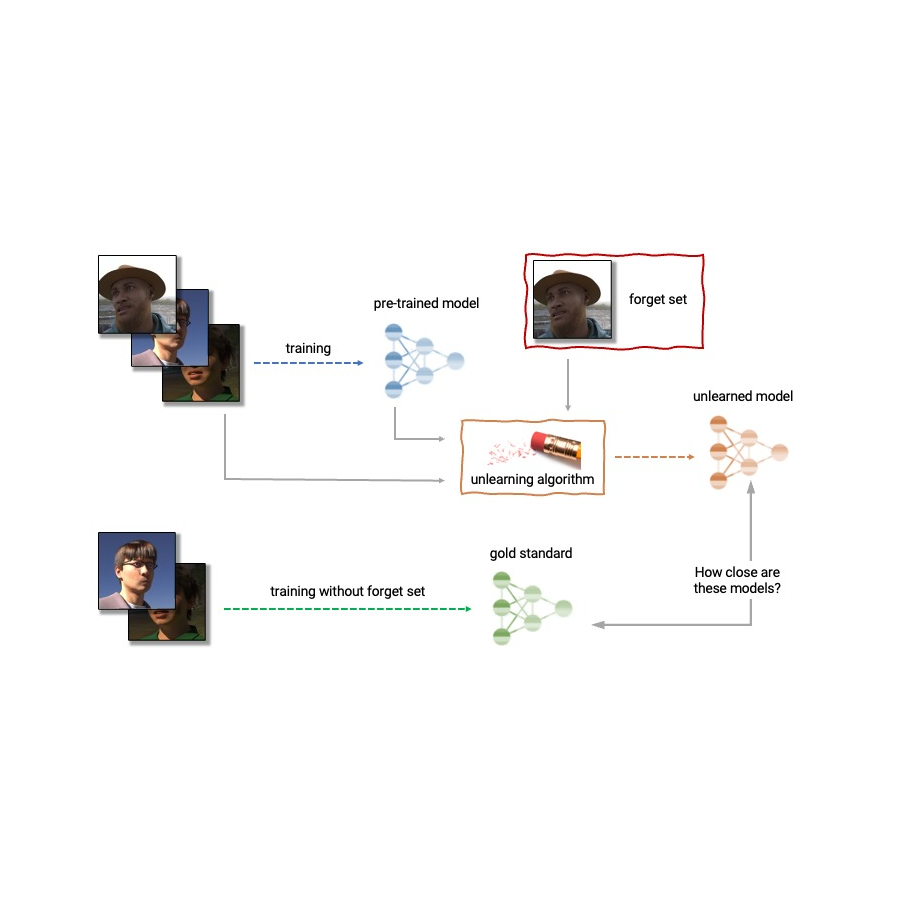
Given the above, machine unlearning is an emergent subfield of machine learning that aims to remove the influence of a specific subset of training examples — the “forget set” — from a trained model. Furthermore, an ideal unlearning algorithm would remove the influence of certain examples while maintaining other beneficial properties, such as the accuracy on the rest of the train set and generalization to held-out examples. A straightforward way to produce this unlearned model is to retrain the model on an adjusted training set that excludes the samples from the forget set. However, this is not always a viable option, as retraining deep models can be computationally expensive. An ideal unlearning algorithm would instead use the already-trained model as a starting point and efficiently make adjustments to remove the influence of the requested data.

Today we’re thrilled to announce that we’ve teamed up with a broad group of academic and industrial researchers to organize the first Machine Unlearning Challenge. The competition considers a realistic scenario in which after training, a certain subset of the training images must be forgotten to protect the privacy or rights of the individuals concerned. The competition will be hosted on Kaggle, and submissions will be automatically scored in terms of both forgetting quality and model utility. We hope that this competition will help advance the state of the art in machine unlearning and encourage the development of efficient, effective and ethical unlearning algorithms.

Machine unlearning applications

Machine unlearning has applications beyond protecting user privacy. For instance, one can use unlearning to erase inaccurate or outdated information from trained models (e.g., due to errors in labeling or changes in the environment) or remove harmful, manipulated, or outlier data.

The field of machine unlearning is related to other areas of machine learning such as differential privacy, life-long learning, and fairness. Differential privacy aims to guarantee that no particular training example has too large an influence on the trained model; a stronger goal compared to that of unlearning, which only requires erasing the influence of the designated forget set. Life-long learning research aims to design models that can learn continuously while maintaining previously-acquired skills. As work on unlearning progresses, it may also open additional ways to boost fairness in models, by correcting unfair biases or disparate treatment of members belonging to different groups (e.g., demographics, age groups, etc.).
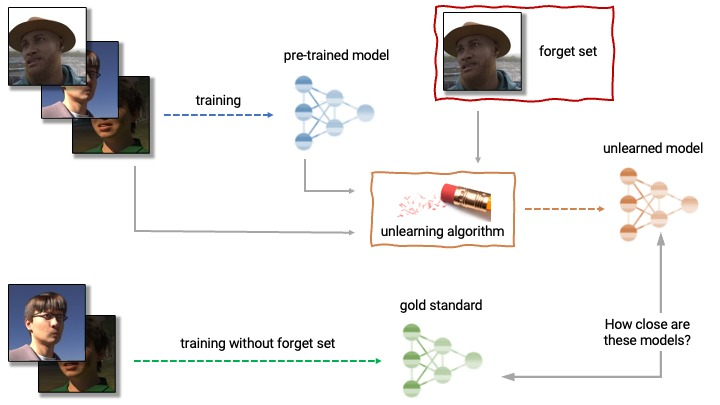
Anatomy of unlearning. An unlearning algorithm takes as input a pre-trained model and one or more samples from the train set to unlearn (the “forget set”). From the model, forget set, and retain set, the unlearning algorithm produces an updated model. An ideal unlearning algorithm produces a model that is indistinguishable from the model trained without the forget set.

Challenges of machine unlearning

The problem of unlearning is complex and multifaceted as it involves several conflicting objectives: forgetting the requested data, maintaining the model’s utility (e.g., accuracy on retained and held-out data), and efficiency. Because of this, existing unlearning algorithms make different trade-offs. For example, full retraining achieves successful forgetting without damaging model utility, but with poor efficiency, while adding noise to the weights achieves forgetting at the expense of utility.

Furthermore, the evaluation of forgetting algorithms in the literature has so far been highly inconsistent. While some works report the classification accuracy on the samples to unlearn, others report distance to the fully retrained model, and yet others use the error rate of membership inference attacks as a metric for forgetting quality [4, 5, 6].

We believe that the inconsistency of evaluation metrics and the lack of a standardized protocol is a serious impediment to progress in the field — we are unable to make direct comparisons between different unlearning methods in the literature. This leaves us with a myopic view of the relative merits and drawbacks of different approaches, as well as open challenges and opportunities for developing improved algorithms. To address the issue of inconsistent evaluation and to advance the state of the art in the field of machine unlearning, we’ve teamed up with a broad group of academic and industrial researchers to organize the first unlearning challenge.

Announcing the first Machine Unlearning Challenge

We are pleased to announce the first Machine Unlearning Challenge, which will be held as part of the NeurIPS 2023 Competition Track. The goal of the competition is twofold. First, by unifying and standardizing the evaluation metrics for unlearning, we hope to identify the strengths and weaknesses of different algorithms through apples-to-apples comparisons. Second, by opening this competition to everyone, we hope to foster novel solutions and shed light on open challenges and opportunities.

The competition will be hosted on Kaggle and run between mid-July 2023 and mid-September 2023. As part of the competition, today we’re announcing the availability of the starting kit. This starting kit provides a foundation for participants to build and test their unlearning models on a toy dataset.

The competition considers a realistic scenario in which an age predictor has been trained on face images, and, after training, a certain subset of the training images must be forgotten to protect the privacy or rights of the individuals concerned. For this, we will make available as part of the starting kit a dataset of synthetic faces (samples shown below) and we’ll also use several real-face datasets for evaluation of submissions. The participants are asked to submit code that takes as input the trained predictor, the forget and retain sets, and outputs the weights of a predictor that has unlearned the designated forget set. We will evaluate submissions based on both the strength of the forgetting algorithm and model utility. We will also enforce a hard cut-off that rejects unlearning algorithms that run slower than a fraction of the time it takes to retrain. A valuable outcome of this competition will be to characterize the trade-offs of different unlearning algorithms.
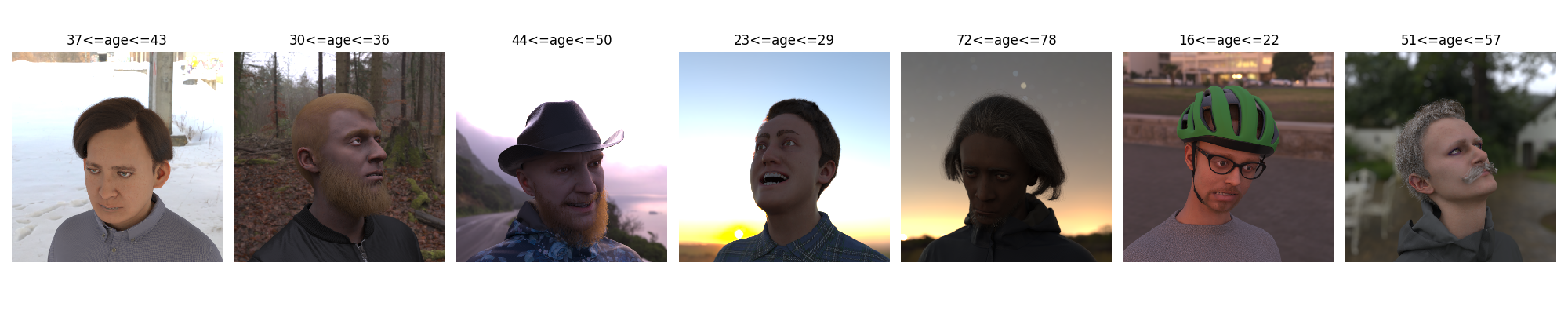
Excerpt images from the Face Synthetics dataset together with age annotations. The competition considers the scenario in which an age predictor has been trained on face images like the above, and, after training, a certain subset of the training images must be forgotten.

For evaluating forgetting, we will use tools inspired by MIAs, such as LiRA. MIAs were first developed in the privacy and security literature and their goal is to infer which examples were part of the training set. Intuitively, if unlearning is successful, the unlearned model contains no traces of the forgotten examples, causing MIAs to fail: the attacker would be unable to infer that the forget set was, in fact, part of the original training set. In addition, we will also use statistical tests to quantify how different the distribution of unlearned models (produced by a particular submitted unlearning algorithm) is compared to the distribution of models retrained from scratch. For an ideal unlearning algorithm, these two will be indistinguishable.

Conclusion

Machine unlearning is a powerful tool that has the potential to address several open problems in machine learning. As research in this area continues, we hope to see new methods that are more efficient, effective, and responsible. We are thrilled to have the opportunity via this competition to spark interest in this field, and we are looking forward to sharing our insights and findings with the community.

Acknowledgements

The authors of this post are now part of Google DeepMind. We are writing this blog post on behalf of the organization team of the Unlearning Competition: Eleni Triantafillou*, Fabian Pedregosa* (*equal contribution), Meghdad Kurmanji, Kairan Zhao, Gintare Karolina Dziugaite, Peter Triantafillou, Ioannis Mitliagkas, Vincent Dumoulin, Lisheng Sun Hosoya, Peter Kairouz, Julio C. S. Jacques Junior, Jun Wan, Sergio Escalera and Isabelle Guyon.

Pay just $29.97 for Microsoft Office Professional 2021 (no subscription!)

Not only is one of the best deals we’ve spotlighted in 2023 available again, but it’s also at an all-time low price. This is your chance to pick up lifetime access to Microsoft Office Professional 2021 for a one-time payment of just $29.97 ($190 off).

The deal is as good as it sounds — no subscription fees or limitations on features. Once you sign up, you’ve got all of the most popular Office software and tools to maximize your productivity. Office Professional 2021 is available for Windows users, but the same savings and price can land you Office Home and Business 2021 if you’re a Mac user.

Samsung’s Galaxy SmartTag 2 spotted in new listing

samsung galaxy smarttag item tracker

Credit: David Imel / Android Authority
  • The sequel to Samsung’s tracking device was spotted on the Bluetooth SIG website.
  • The listing reveals it will have Bluetooth 5.3.
  • The Smart Tag 2 could make an appearance during July’s Unpacked event.

Back in April, a report claimed Samsung was working on a Galaxy SmartTag 2 and that it could be revealed at the Unpacked showcase in July. A new listing appears to confirm the existence of the next-generation tracking device.

As discovered by 9to5Google, the SmartTag 2 has appeared on the Bluetooth Special Interest Group’s (Bluetooth SIG) website. The listing doesn’t provide much detail about the device other than a short description.

On-device diffusion plugins for conditioned text-to-image generation

In recent years, diffusion models have shown great success in text-to-image generation, achieving high image quality, improved inference performance, and expanding our creative inspiration. Nevertheless, it is still challenging to efficiently control the generation, especially with conditions that are difficult to describe with text.

Today, we announce MediaPipe diffusion plugins, which enable controllable text-to-image generation to be run on-device. Expanding upon our prior work on GPU inference for on-device large generative models, we introduce new low-cost solutions for controllable text-to-image generation that can be plugged into existing diffusion models and their Low-Rank Adaptation (LoRA) variants.

Text-to-image generation with control plugins running on-device.

Background

With diffusion models, image generation is modeled as an iterative denoising process. Starting from a noise image, at each step, the diffusion model gradually denoises the image to reveal an image of the target concept. Research shows that leveraging language understanding via text prompts can greatly improve image generation. For text-to-image generation, the text embedding is connected to the model via cross-attention layers. Yet, some information is difficult to describe by text prompts, e.g., the position and pose of an object. To address this problem, researchers add additional models into the diffusion to inject control information from a condition image.

Common approaches for controlled text-to-image generation include Plug-and-Play, ControlNet, and T2I Adapter. Plug-and-Play applies a widely used denoising diffusion implicit model (DDIM) inversion approach that reverses the generation process starting from an input image to derive an initial noise input, and then employs a copy of the diffusion model (860M parameters for Stable Diffusion 1.5) to encode the condition from an input image. Plug-and-Play extracts spatial features with self-attention from the copied diffusion, and injects them into the text-to-image diffusion. ControlNet creates a trainable copy of the encoder of a diffusion model, which connects via a convolution layer with zero-initialized parameters to encode conditioning information that is conveyed to the decoder layers. However, as a result, the size is large, half that of the diffusion model (430M parameters for Stable Diffusion 1.5). T2I Adapter is a smaller network (77M parameters) and achieves similar effects in controllable generation. T2I Adapter only takes the condition image as input, and its output is shared across all diffusion iterations. Yet, the adapter model is not designed for portable devices.

The MediaPipe diffusion plugins

To make conditioned generation efficient, customizable, and scalable, we design the MediaPipe diffusion plugin as a separate network that is:

  • Plugable: It can be easily connected to a pre-trained base model.
  • Trained from scratch: It does not use pre-trained weights from the base model.
  • Portable: It runs outside the base model on mobile devices, with negligible cost compared to the base model inference.
Method    Parameter Size     Plugable     From Scratch     Portable
Plug-and-Play    860M*     ✔️        
ControlNet    430M*     ✔️        
T2I Adapter    77M     ✔️     ✔️    
MediaPipe Plugin    6M     ✔️     ✔️     ✔️
Comparison of Plug-and-Play, ControlNet, T2I Adapter, and the MediaPipe diffusion plugin.
* The number varies depending on the particulars of the diffusion model.

The MediaPipe diffusion plugin is a portable on-device model for text-to-image generation. It extracts multiscale features from a conditioning image, which are added to the encoder of a diffusion model at corresponding levels. When connecting to a text-to-image diffusion model, the plugin model can provide an extra conditioning signal to the image generation. We design the plugin network to be a lightweight model with only 6M parameters. It uses depth-wise convolutions and inverted bottlenecks from MobileNetv2 for fast inference on mobile devices.

Overview of the MediaPipe diffusion model plugin. The plugin is a separate network, whose output can be plugged into a pre-trained text-to-image generation model. Features extracted by the plugin are applied to the associated downsampling layer of the diffusion model (blue).

Unlike ControlNet, we inject the same control features in all diffusion iterations. That is, we only run the plugin once for one image generation, which saves computation. We illustrate some intermediate results of a diffusion process below. The control is effective at every diffusion step and enables controlled generation even at early steps. More iterations improve the alignment of the image with the text prompt and generate more detail.

Illustration of the generation process using the MediaPipe diffusion plugin.

Examples

In this work, we developed plugins for a diffusion-based text-to-image generation model with MediaPipe Face Landmark, MediaPipe Holistic Landmark, depth maps, and Canny edge. For each task, we select about 100K images from a web-scale image-text dataset, and compute control signals using corresponding MediaPipe solutions. We use refined captions from PaLI for training the plugins.

Face Landmark

The MediaPipe Face Landmarker task computes 478 landmarks (with attention) of a human face. We use the drawing utils in MediaPipe to render a face, including face contour, mouth, eyes, eyebrows, and irises, with different colors. The following table shows randomly generated samples by conditioning on face mesh and prompts. As a comparison, both ControlNet and Plugin can control text-to-image generation with given conditions.

Face-landmark plugin for text-to-image generation, compared with ControlNet.

Holistic Landmark

MediaPipe Holistic Landmarker task includes landmarks of body pose, hands, and face mesh. Below, we generate various stylized images by conditioning on the holistic features.

Holistic-landmark plugin for text-to-image generation.

Depth

Depth-plugin for text-to-image generation.

Canny Edge

Canny-edge plugin for text-to-image generation.

Evaluation

We conduct a quantitative study of the face landmark plugin to demonstrate the model’s performance. The evaluation dataset contains 5K human images. We compare the generation quality as measured by the widely used metrics, Fréchet Inception Distance (FID) and CLIP scores. The base model is a pre-trained text-to-image diffusion model. We use Stable Diffusion v1.5 here.

As shown in the following table, both ControlNet and the MediaPipe diffusion plugin produce much better sample quality than the base model, in terms of FID and CLIP scores. Unlike ControlNet, which needs to run at every diffusion step, the MediaPipe plugin only runs once for each image generated. We measured the performance of the three models on a server machine (with Nvidia V100 GPU) and a mobile phone (Galaxy S23). On the server, we run all three models with 50 diffusion steps, and on mobile, we run 20 diffusion steps using the MediaPipe image generation app. Compared with ControlNet, the MediaPipe plugin shows a clear advantage in inference efficiency while preserving the sample quality.

Model     FID↓     CLIP↑     Inference Time (s)
Nvidia V100     Galaxy S23
Base     10.32     0.26     5.0     11.5
Base + ControlNet     6.51     0.31     7.4 (+48%)     18.2 (+58.3%)
Base + MediaPipe Plugin     6.50     0.30     5.0 (+0.2%)     11.8 (+2.6%)
Quantitative comparison on FID, CLIP, and inference time.

We test the performance of the plugin on a wide range of mobile devices from mid-tier to high-end. We list the results on some representative devices in the following table, covering both Android and iOS.

Device     Android     iOS
    Pixel 4     Pixel 6     Pixel 7     Galaxy S23     iPhone 12 Pro     iPhone 13 Pro
Time (ms)     128     68     50     48     73     63
Inference time (ms) of the plugin on different mobile devices.

Conclusion

In this work, we present MediaPipe, a portable plugin for conditioned text-to-image generation. It injects features extracted from a condition image to a diffusion model, and consequently controls the image generation. Portable plugins can be connected to pre-trained diffusion models running on servers or devices. By running text-to-image generation and plugins fully on-device, we enable more flexible applications of generative AI.

Acknowledgments

We’d like to thank all team members who contributed to this work: Raman Sarokin and Juhyun Lee for the GPU inference solution; Khanh LeViet, Chuo-Ling Chang, Andrei Kulik, and Matthias Grundmann for leadership. Special thanks to Jiuqiang Tang, Joe Zou and Lu wang, who made this technology and all the demos running on-device.

-- Get the right stuff from a partner you trust. --

Partners

-- IT NEWS --

Blog

admin December 16th, 2025

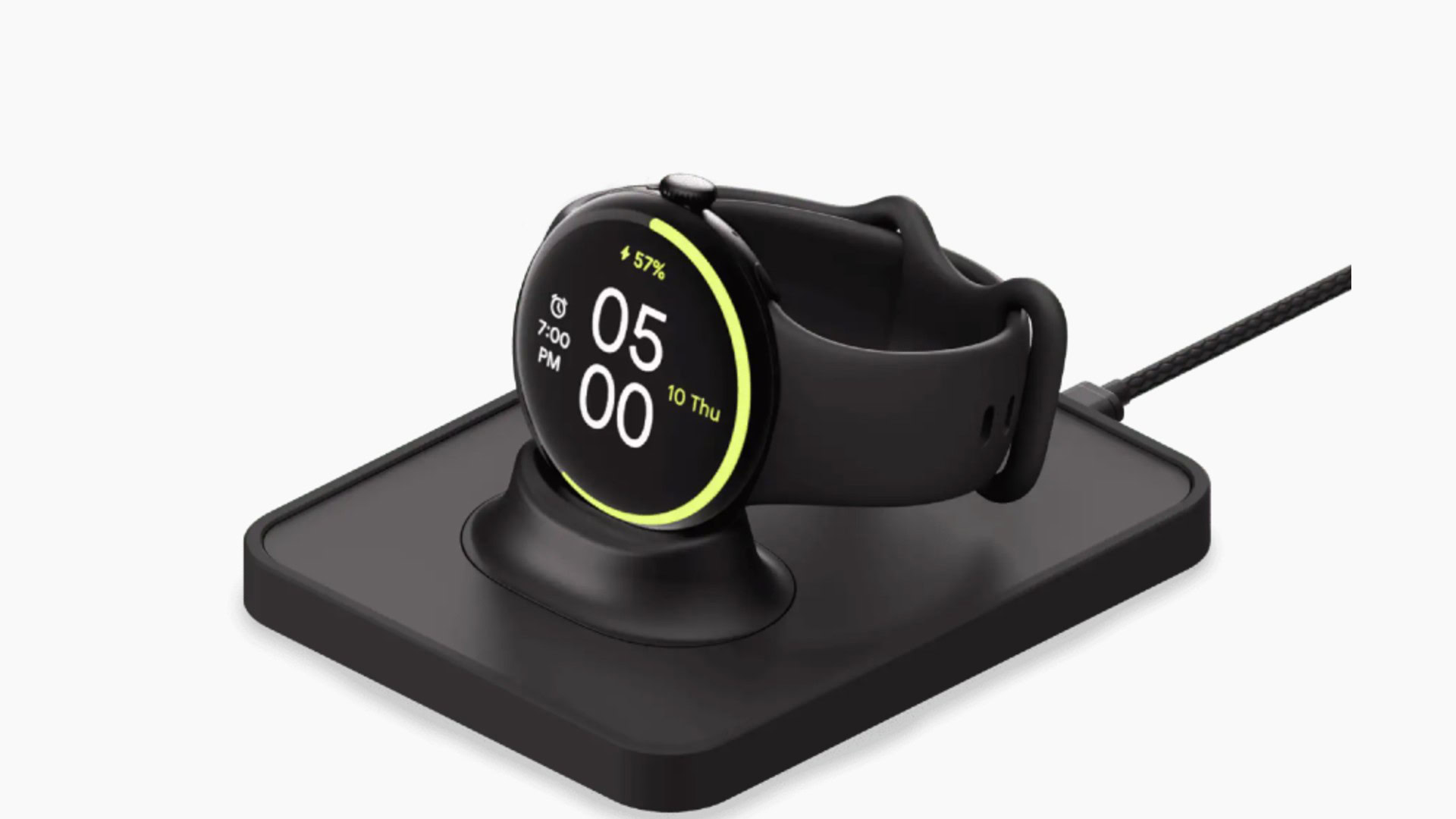
Credit: Google TL;DR Google is now selling the Mous Pixel Watch Charger, the first Google-certified third-party charger for the Pixel […]

admin December 16th, 2025

We’ve seen some unexpected battery behavior in the Pixel 10 series. Battery life is typically okay for us on Google’s […]

admin December 11th, 2025

Credit: Edgar Cervantes / Android Authority TL;DR Spotify is getting a new “Prompted Playlist” feature to help users create more […]